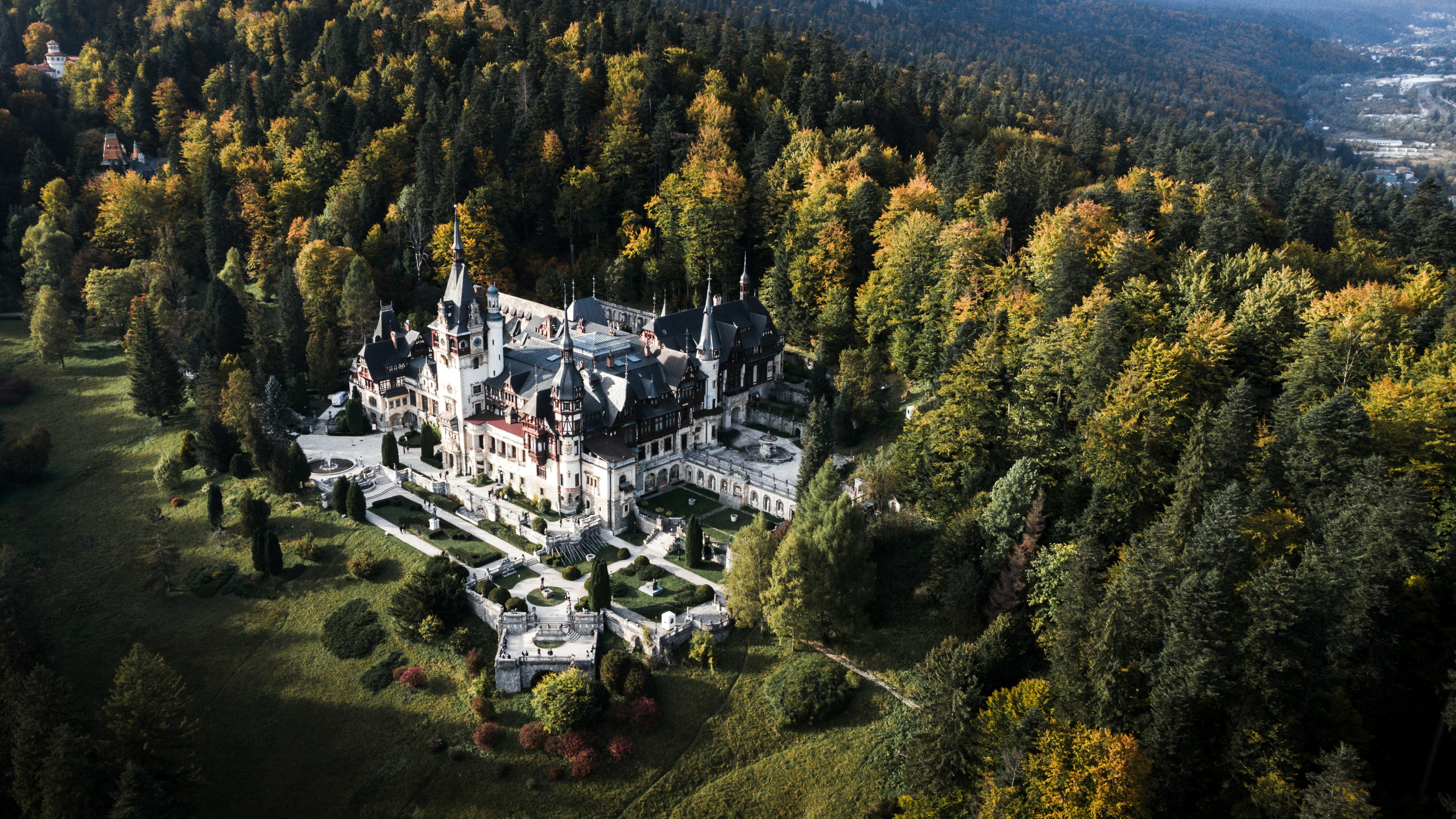
Most visitors arrive at Peleș expecting something very old. The steep roofs, the timbered gables, the turrets rising out of the Carpathian forest — it has all the grammar of a medieval stronghold, and the setting to match. Then you learn the date, and the whole picture tilts pleasantly on its axis. Peleș is younger than the telephone. When its first stones were laid, the game of lawn tennis had only just been invented; by the time it was finished, the First World War had begun. This is not a castle that history handed down. It is a castle that a king, quite deliberately, invented.
That king was Carol I — born a prince of Hohenzollern-Sigmaringen, a cadet of the same house that gave Germany its emperors, and invited in 1866, at just twenty-seven, to rule a young, uncertain Romania. He came from a Europe full of grand old family castles to a country that had almost none of the kind he was used to, and the absence seems to have troubled him. The story most fondly repeated is that he first saw the Sinaia valley in the summer of 1866 and never quite got it out of his head; the land was bought in 1872, and the dream began to take shape in stone soon after.12
A mountain chosen on purpose
Sinaia was not a random beauty spot. It sat on the road between Wallachia and Transylvania, in mountains that reminded Carol of the German landscapes of his youth, and beside an old monastery that lent the place a certain gravity. He wanted a summer residence, yes — but one that would say something. A modern monarchy needed a seat that looked as though it had always been there, planted among the peaks like an argument that the Romanian crown belonged in the first rank of European houses.
The site had its own opinions. The ground was waterlogged and unstable, and the first years were spent not raising walls but wrestling the mountain into a state that could hold them.3 Anyone who has tried to hang a picture in an old house will feel a flicker of sympathy for what followed.
A castle that took a lifetime
The foundation stone was laid in 1875, and the work that began then did not truly end until Carol's death in 1914 — a span of nearly four decades, interrupted along the way by the Romanian War of Independence of 1877–78, when the money and the men were needed elsewhere.4
Three architects shaped it in turn. The Viennese Wilhelm von Doderer drew the first plans — three of which the king rejected outright, which tells you a good deal about the client. His assistant Johannes Schultz saw the first castle through to its inauguration on 7 October 1883, reworking the designs into the German Neo-Renaissance silhouette we recognise today. Then came the Bohemian Karel Liman, who from the 1890s until 1914 did not so much finish the castle as transform it — raising the great central tower to sixty-six metres and adding many of the rooms visitors now queue to see.25
By the end there were some 160 rooms across 3,200 square metres, built at a cost — depending on which contemporary account you trust — running into the millions of gold lei.67 It was, by any measure, an extravagance. It was also, as it turned out, a rather clever one.
Why it looks the way it looks
The style was not an accident of taste. German Neo-Renaissance was the fashionable idiom of the newly proclaimed German Empire — the visual language of European legitimacy — and Carol chose it with intent. Scholars now read Peleș as a piece of architecture doing political work: a Hohenzollern prince telling Romania, and the wider continent, that his adopted country was firmly, unarguably European.5 The timbered gables even echo Burg Hohenzollern, the towering ancestral castle of his dynasty in south-western Germany — not far from the Sigmaringen palace where he was born, in 1839, and raised.89 The castle is, in a sense, a homesick prince's memory of home — rebuilt grander, on a Romanian mountain.
The machine behind the fairy tale
Here is where the medieval mask slips, delightfully, to reveal the modern face beneath. For all its antique looks, Peleș was one of the most technologically advanced houses of its age. It drew electric light from its own power plant, and is often called the first castle in Europe lit entirely by its own current. That claim deserves one honest word. An English country house, Cragside, had beaten every castle to electric light from water power some years earlier, so Peleș was not the first building in Europe to be electrified.10 But as a genuine castle, lit throughout from its own plant at the very dawn of the electric age, it stands among the first of its kind2 — which is remarkable enough. Behind the carved panelling ran central heating — installed by the Polish inventor Franciszek Rychnowski, whom the king rewarded with a gold medal — along with a central vacuum system, two lifts, a telephone line, and, best of all, a great stained-glass ceiling in the Hall of Honour that slides open at the touch of an electric motor.811
Imagine it: a castle dressed as the fifteenth century, quietly running on the conveniences of the twentieth, decades before most European capitals could manage the same.
The wonder is inside
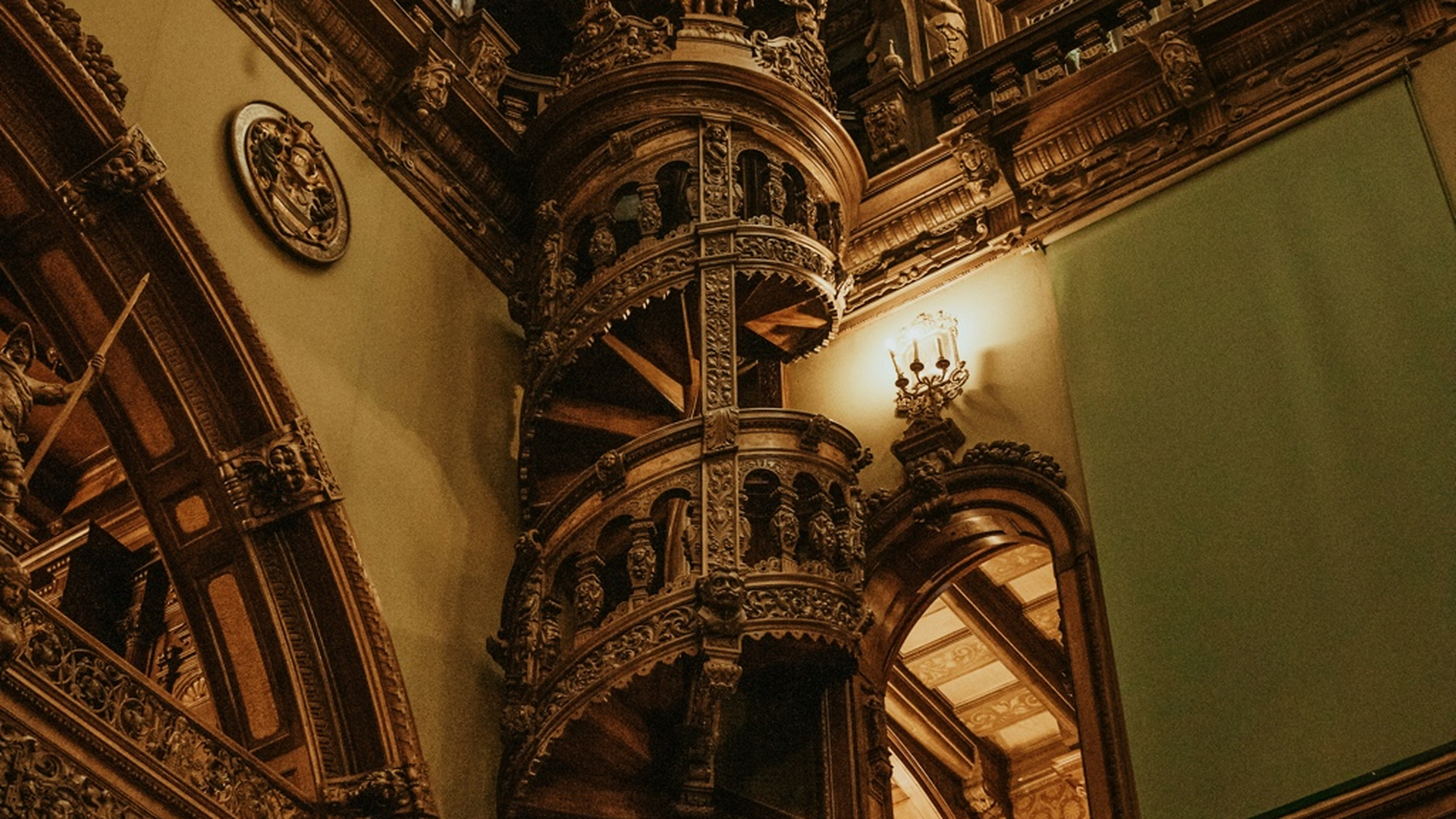
The exterior, for all its drama, is the overture. The real performance waits behind the door — walnut carved until it seems to breathe, stained glass fired in the great Munich workshops, a little theatre whose ceiling was painted by a young Gustav Klimt before the world knew his name.6 So thoroughly did contemporaries feel this that the castle's first proper biography was written not by a tourist but from inside the household: Léo Bachelin, the king's own French librarian, whose illustrated Castel-Pelesch remains the earliest loving account of what Carol built.12
Many visitors, we suspect, come for the wrong castle — drawn up from Bucharest by the promise of Dracula somewhere in these hills — and leave having fallen instead for Carol's European creation.
A word of practical advice, then, for anyone tempted. Come early in the day, and outside the summer crush if you can — a Thursday or Friday morning, before the coach tours are scheduled, is ideal, as is the later part of the afternoon once the groups have moved on. Peleș is one of the most visited monuments in Romania, and it rewards a quiet hour far more than a crowded one. Give it more time than you think you will need, because there is a great deal to take in. Rather than waiting to join a guided group, consider the self-guided visit, which lets you set your own pace and linger wherever you please. And do not overlook Pelișor — the smaller royal castle a short walk away on the same estate, a gentler and more intimate companion to its grander neighbour, and easily folded into the same afternoon.
Sources
Footnotes
-
Histoires Royales — Le château de Peleș fête ses 150 ans: https://histoiresroyales.fr/chateau-de-peles-residence-royale-carpates-fete-150-ans/ ↩
-
Muzeul Național Peleș — History of Peleș Castle: https://peles.ro/en/despre/istoricul-castelului-peles/ ↩ ↩2 ↩3
-
Adevărul — Peleșul, visul nebunesc al lui Carol I: https://adevarul.ro/stiri-locale/ploiesti/pelesul-visul-nebunesc-al-lui-carol-i-1656746.html ↩
-
Wikipédia (FR) — Château de Peleș: https://fr.wikipedia.org/wiki/Ch%C3%A2teau_de_Pele%C8%99 ↩
-
Castelul Peleș, expresie a fenomenului istorist de influență germană — arhitectura-1906: https://arhitectura-1906.ro/2012/04/castelul-peles-expresie-a-fenomenului-istorist-de-influeta-germana/ ↩ ↩2
-
Historia — Călătorie regală: Castelul Peleș: https://historia.ro/sectiune/travel/calatorie-regala-castelul-peles-585003.html ↩ ↩2
-
Wikipedia (EN) — Peleș Castle: https://en.wikipedia.org/wiki/Pele%C8%99_Castle ↩
-
Wikipedia (DE) — Schloss Peleș: https://de.wikipedia.org/wiki/Schloss_Pele%C8%99 ↩ ↩2
-
Peleș National Museum — King Carol I: https://en.peles.ro/historical-figures/king-carol-i/ ↩
-
Guinness World Records — First house powered by hydro-electricity (Cragside): https://www.guinnessworldrecords.com/world-records/360591-first-house-powered-by-hydro-electricity ↩
-
Ancient Origins — Modern Comfort and Traditional Opulence… Peleș Castle: https://www.ancient-origins.net/ancient-places-europe/modern-comfort-and-traditional-opulence-perfect-combination-pele-castle-007572 ↩
-
Léo Bachelin, Castel-Pelesch (1890s) — antiquarian record: https://www.livre-rare-book.com/book/5472433/23483 ↩